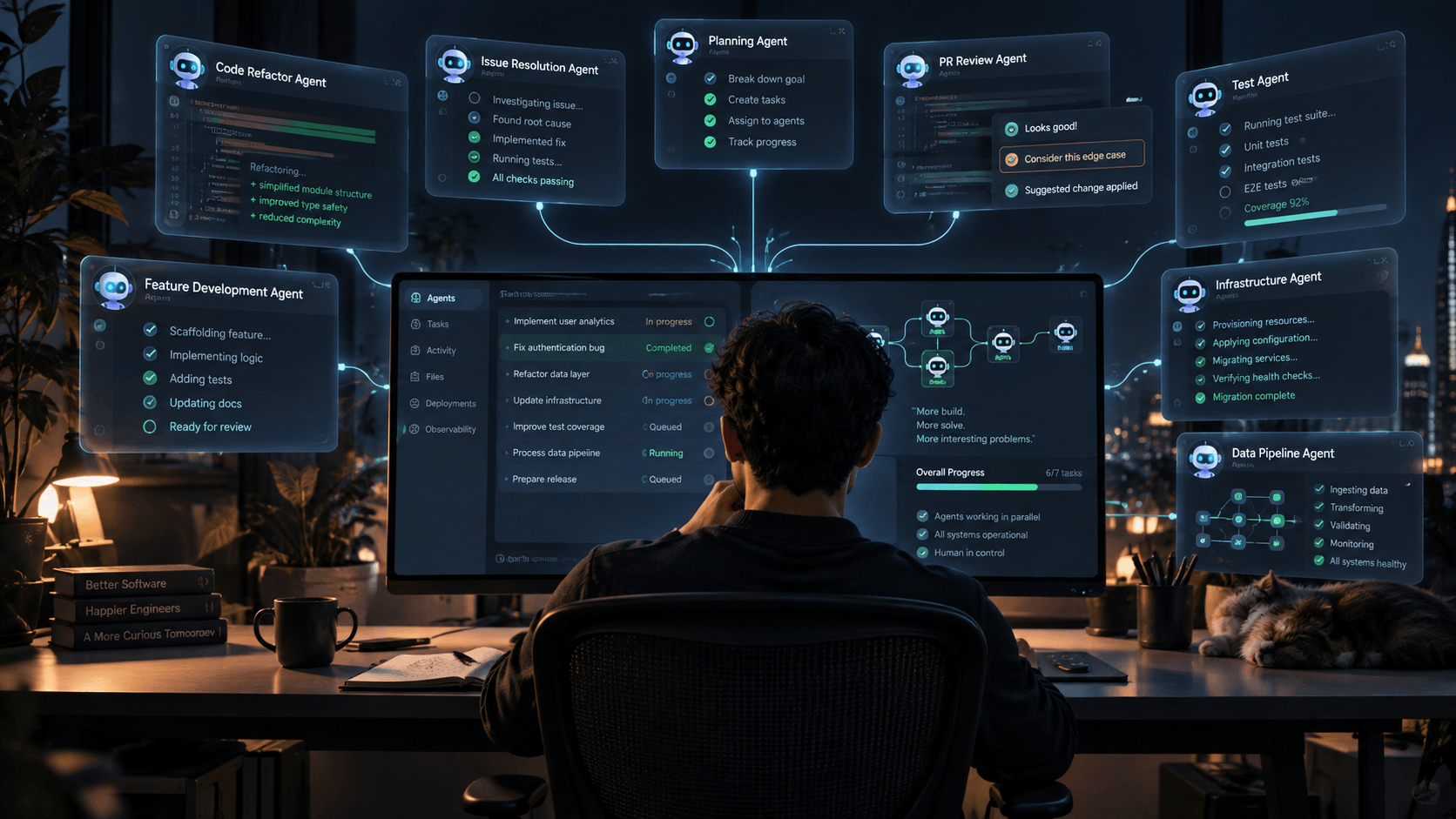
While I have followed the development of AI and agents in the context of software engineering closely over the last years, I have myself not been “AI-pilled” until recently. I wrote most of my code on my own in VS code and have occasionally been using the AI chat in the sidebar to hand off smaller tasks to Github Copilot. While I used Github Copilot and the autocomplete features, I did not have a Claude or ChatGPT subscription until July 2025.
What got me interested
I follow Armin Ronacher closely since I find his writings and his occasional conference talks very interesting. His opinions are very informed and his argumentation style is nuanced which I enjoy a lot. Through him, I got to know pi (the coding agent) and his creator Mario Zechner. I used pi occasionally but kept writing code myself and did not embrace the agent lifestyle that was becoming popular since at least the start of 2025.
Finally, in July 2026 I decided to give it a go as so many people that I follow for technical advice as well as a coworker of mine seemed to be hooked. Github Copilot, what I was using before in VS code, got a lot more expensive and we had to evaluate alternatives at work. So I got a Claude subscription and got started with the Claude desktop app.
What got me hooked
Since then, I have stopped writing any code by hand. I regularly run multiple agents in parallel to work on multiple larger projects. I have tackled multiple large and complex refactorings that I wanted to do for months or years and had a good idea where I wanted to go but never found the time to actually write the code. I improved the performance of our code in multiple substantial ways simply by setting agents to the task and giving them the access or tools that they need to do their work. I completely changed the way I review PRs since I now let agents review the technical details and focus on the upper level structure. Finally, I organise larger projects differently, since it is now so easy to sketch out an idea and let the agent handle creating tickets and tracking progress.
In a matter of months, from July to September, my coding workflow has changed fundamentally. I used to focus on one task for long periods of time, trying to get the context into my head and go deep into the code. Now I start an agent session, let the agent track the progress in linear, and try to keep it working towards the goal I have in mind.
What got me excited
Previously, a significant part of my day was reserved for looking at errors we had in our many data pipelines. Now, every data issue we have is handled by an agent first that either solves the issue completely or provides valuable context. This way, solving 99% of issues is either accepting the solution outright or one additional line telling the agent what to do next.
While I was at first worried that code produced by agents (not just mine, we have many people using agents at work) would lower the quality of our systems, agents have helped us improve our tests and resilience through better tools. We migrated all our systems from Azure Monitor to Sentry, let agents write testing frameworks for large parts of previously less-than-ideal tested code, and migrated our complete Azure infrastructure from a partial Bicep setup to terraform for with agentic help.
We have even used agents to bring code closer to the users of our internal platforms. I talk a lot internally about how I make use of AI in my everyday workflows. I have helped colleagues that have no technical background make use of AI. This includes creating PRs for small changes that they want to make to systems they rely on.
One example: We have a system the produces client reports as PDFs. Every month, there are some fixes that need to be made due to changing requirements or small details that my colleagues would like to change. Previously, every such change had to go through a software engineer. Now, my colleagues can use a preview editor that auto-reloads once a change is made. This way, they can let an agent make changes to the reports and then view the changes to their reports live. It’s basically like v0 from Vercel but for PDF reports. I came up with the idea and an agent implemented everything.
As cringe as it might sound: I have become an Agent-native.
What I still do by hand
Most importantly, I still write all my blog posts by hand. I think that Craig Mod is right in his newest newsletter that “Claude Voice” is everywhere and that it is unbearable. AI writing is easily detectable for the attentive reader and in my eyes will always be an affront to the reader. If I want to read AI text, I might as well prompt it myself.
Coming back to a software context, I think it is essential to be in control of the direction where you want to go. If you let the agent drive unattended, you will have trouble navigating yourself. Especially once you have to deal with questions from colleagues, problems, or errors in the code.
You have to set the direction and ultimately make sure the agent is producing something that adheres to your standards. Of course, you can let agents do the QA or use code quality tools, but you will have to be conscious of your agent’s work and steer it to get a result of good quality. Agents can be incredibly intelligent, come up with surprisingly brillant solutions, but still make the simplest errors. This can be seen when you let agents write tests. I catch frontier models writing assert-equals for constants every day.
The future is unavoidable
I can relate to every software engineer that is doubtful of the quality of naive agentic coding or has moral doubts about AI models and their training. I can also understand worrying about the end of the software engineering discipline as a whole and agents taking over. But it is my strong believe that these worries and doubts will not slow down or even stop the developments that were set in motion.
Agentic coding is and will be a thing. Cheaper and more open models (Kimi, GLM, Muse) have demonstrated that what was expensive and supply-constraint frontier intelligence a couple of months before is now a commodity. And even though other labs have reproduced frontier results from a few months back, Anthropic and OpenAI are still in the lead and their newest models keep making significant leaps.
In short: Agentic coding is unavoidable and will become ubiquitous. Whether we will run the models locally or in the cloud, use open source or closed models: if you are a developer, you should at least try out these new tools.
You might even like them - just like I came to like them.