
You might have heard about Pi, the minimal coding agent. If you ever wanted to learn about how coding agents work behind the scenes, you should look at this project. Claude Code, Codex, GitHub Copilot: all the coding agents use a similar architecture. Pi as an idea and project will teach you about the basics of this architecture and what makes these agents work.
For me, the most interesting announcement of this month was the release of Pi Durable. Pi Durable makes Pi, as a harness, embeddable everywhere. It has the name “Durable” since it builds the harness on top of a durable workflow which can be stopped and reliably started back up at any point in time.
One benefit of a durable harness is that the conversation you are having can be restarted later without having to keep the original session alive.
In short: You can now (quite easily) build your own ChatGPT!
Taking The Harness Wherever You Go
Even better: You can embed an agent wherever you want (as long as you can execute some TypeScript) and give it access to whatever tools you see fit.
You can keep your LLM conversations entirely private or use local AI if you have the necessary GPU power. If you ever wanted your own personal assistant, now is the time!
Your Personal Assistant
Personal assistants have been a hot topic since OpenClaw from Peter Steinberger took off and became famous. The idea is immediately appealing: Let LLMs make your life easier and do the boring tasks: Answering your email, making appointments, managing your calendar, doing some research, or updating some shopping list.
The most crucial thing for a functioning agent is access to the necessary tools and the interface with which you communicate with your agent. It needs access to your email, your calendar, your phone, your files, or more. As these agents need access to more and more systems, deploying them is no longer easy.
Hermes Agent offers a paid service where they manage your agent for you. But then you lose control over all aspects of your setup. Having a good personal assistant means trusting it with a lot of access to your most important data. Using a third-party service means trusting that third party with access to that data. It also might mean you have to open up any locally running services for outside access.
Actually Your Personal Assistant
Talking about locally running services: I think that Home Assistant as a project has grown so large now because it enables you to own and control the whole infrastructure of your own smart home system. You are free to embed all kinds of devices in all kinds of ways.
In the same sense, I think that a personal assistant needs to be fully owned and controlled by you. Personally, I do not own a lot of GPU compute, so I have to buy the inference from the large providers (OpenAI, Anthropic) but at least I can own the environment in which my personal assistant agent runs.
Building Your Own Agent
The inspiration for this blog post came from this tweet. I saw the image, it clicked, and I knew what I wanted to do. I wanted to build my own agent.
- We already have a family calendar. So it can manage my own calendar and the shared one. It should also be able to read my email.
- I have an extensive smart home system and an MCP server running for it. I want to monitor my Home Assistant sensors and use that information to generate daily reports.
- Interacting with the agent through chats is great. But often, I want to generate a report or save something for later. I need a way to save notes or documents that are agent generated and human edited.
I told my coding agent to take Pi Durable and build upon it. A few hours and a few prompts later I had something called Daylight.
Let There Be Daylight
Daylight is there to manage the boring parts of my daily life for me.
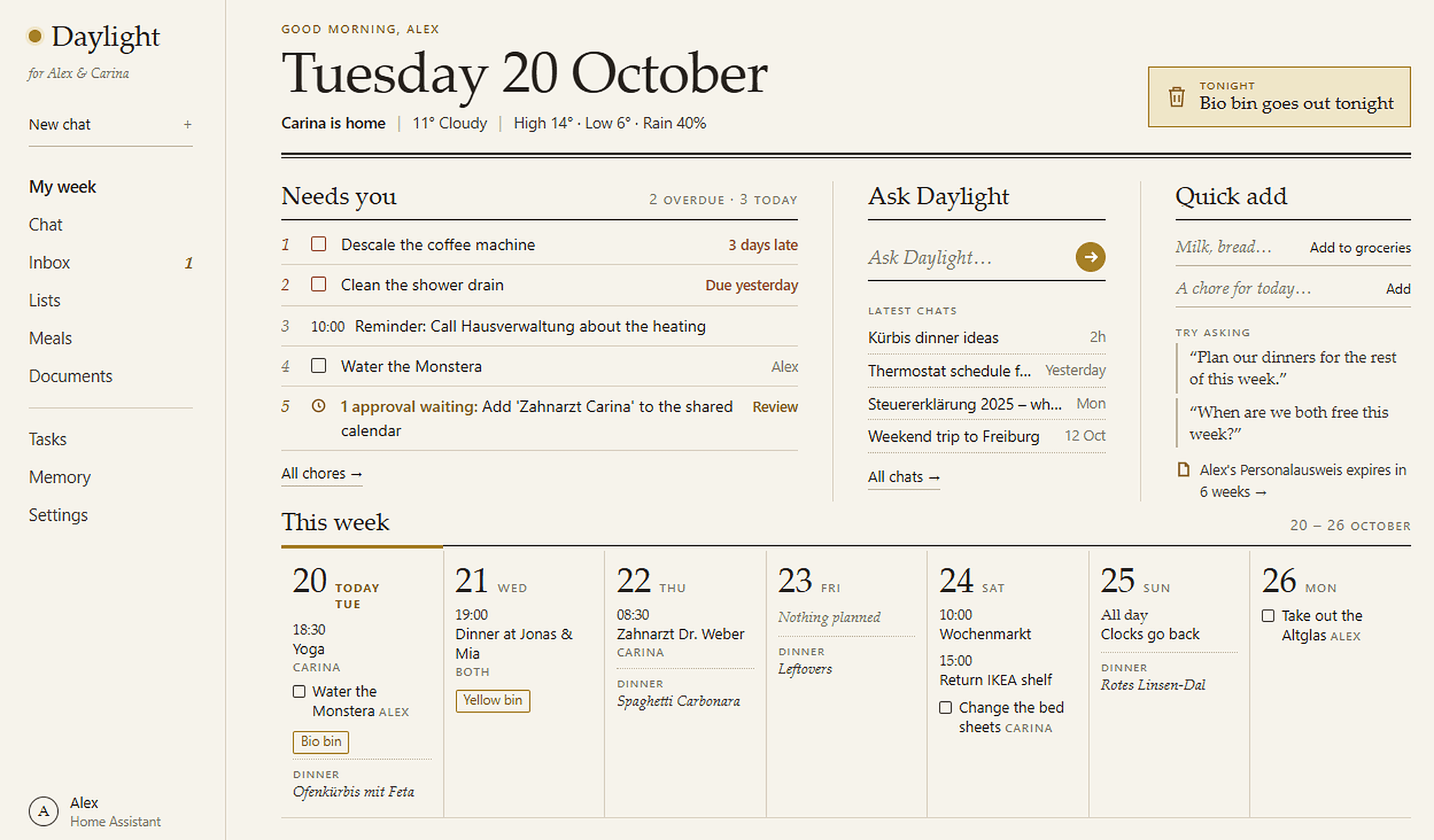
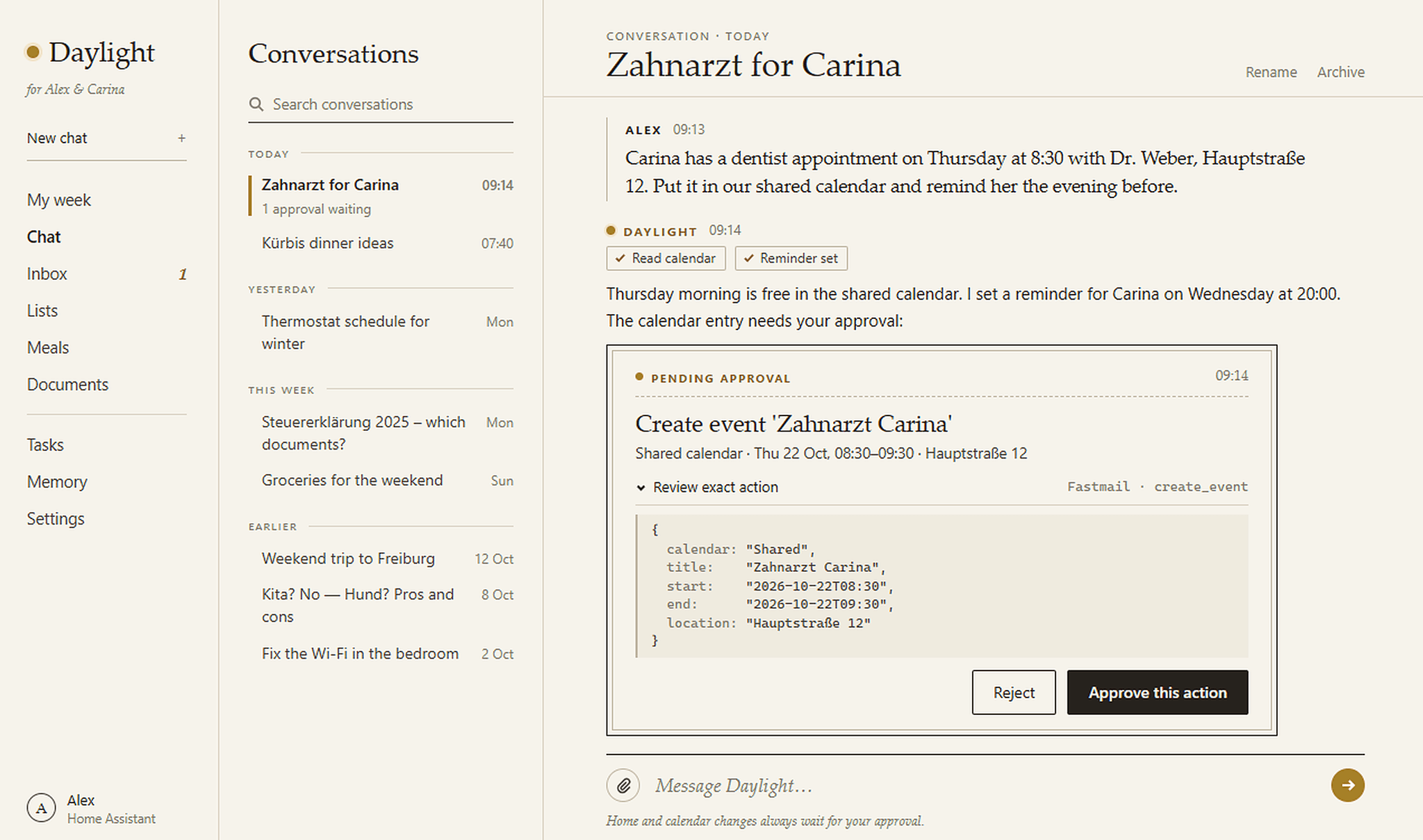
- I can chat with an LLM through the web interface and it will use different tools (calendar, email, smart home, chores list, groceries list).
- I can create profiles for different users and assign tasks to different users.
- It will tell me what I have to do next by looking at my calendar and all open chores. When it wants to change something, I approve every single change.
- I can mention chores in conversations, tell it to mark them as done or create new ones through the conversation.
- I get notifications for certain events or after setting a reminder in a conversation with an LLM.
- I can create scheduled tasks like daily smart home reports where an agent will check my temperature and humidity sensor history and notify me about possible problems with mould.
- I can create and edit documents (either through a conversation or by hand) and mention them in conversations with LLMs. Through that, I can create travel itineraries or shopping lists.
The possibilities are endless. I have full control over which tools I provide and how the access to these tools is organized. In Daylight, different profiles can have different MCP servers configured so that different profiles can have different email accounts or calendars.
For my wife, who needs to follow a special diet, I added a feature where I can add recipes and let the agent create a meal plan for the week. Based on the recipes, it can update our groceries shopping list.
To help with meal planning, she can configure a task that runs every Sunday that makes suggestions for the next week based on the events in the calendar. She can then suggest changes and add the necessary ingredients to our groceries list.
Finally, I copied another idea from Pi. I made Daylight self-aware and let it edit some of its own configuration. It can also help with questions about itself from the users since it has access to its source code and docs.
The last step was to let my coding agent deploy Daylight to my Home Assistant as an addon.
It’s a New World
Writing something like this used to take weeks of work in my spare time, if I did not lose interest or something else came up that I had to spend my free time on.
Now, I can wish a system like this into existence in a few hours while I do something else. I have full creative control and I can design something that fits my specific needs.
Pi Durable is an amazing framework. It helps you embed an agent into any place you like. For me, it made creating a personal assistant with helpful tools to organize the boring parts of my life incredibly easy.
And the best part: I own all my data and I own the agent. All I have to rent is the inference and I could change that in one prompt.